
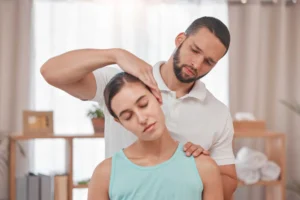
Persistent neck tightness that creeps into the shoulder, or a shoulder ache that never quite responds to rest, is frequently treated as two separate problems. Biomechanically, they are often one. A neck pain chiropractor Cape Coral, FL residents consult evaluates the junction where the neck meets the upper back, the small muscles at the base of the skull and the shoulder blade mechanics that connect them. This guide breaks down how these regions influence each other and how structural, non-invasive care addresses the whole kinetic chain.
The Cervicothoracic Junction: Where the Neck Meets the Upper Back
The cervicothoracic junction is the transition zone between the seventh cervical vertebra and the first thoracic vertebra. Above it, the spine is mobile and designed for rotation and fine head positioning. Below it, the upper back is stiffer, anchored by the rib cage. Because the junction connects a flexible region to a rigid one, it concentrates stress, and it is one of the most common sites of restricted motion and muscular tension.
How Forward Head Posture Overloads the Chain
When the head drifts forward of the shoulders, as it does during phone use, laptop work or long drives, the neck extensors must work harder to hold it up. The further forward the head travels, the longer the leverage arm and the greater the load on the lower cervical segments and the junction. Over time, the upper back may round, the shoulders may roll forward and the natural cervical spine curvature can flatten, a pattern that quietly feeds both neck and shoulder symptoms.
Why a Stiff Upper Back Pushes Work onto the Neck
If the thoracic spine does not rotate and extend well, the cervical segments compensate by moving more than they are built to. This extra demand can irritate facet joints, tighten the trapezius and levator scapulae and leave the neck feeling both sore and stiff. Restoring upper back mobility is therefore a central part of treating neck pain rather than a side issue.
Suboccipital Tension and Upper Cervical Dysfunction
At the base of the skull, a small group of suboccipital muscles fine-tunes head position and sends dense sensory information to the brain about where the head is in space. When the upper cervical joints become restricted or misaligned, these muscles shorten and guard, which can produce a deep, band-like tightness behind the head.
Greater Occipital Nerve Irritation
The greater occipital nerve passes through and around the suboccipital muscles on its way to the scalp. Tight tissue and joint restriction at the top of the neck can irritate it, producing headaches that begin at the skull base and travel toward the crown or behind the eyes. This pattern, often described as cervicogenic headache, originates in the neck, so addressing the cervical source is essential for supporting lasting comfort.
Signs the Upper Neck May Be Involved
- Tension headaches that start where the skull meets the neck
- Reduced rotation when turning to check a blind spot
- A sense of pressure behind the eyes or around the temples
- Eye strain or a feeling of imbalance after screen use
- Stiffness that returns after periods of sitting still
The Neck–Shoulder Kinetic Chain
The shoulder blade, or scapula, sits on the rib cage and depends on muscles that attach directly to the neck and upper back. When it moves well, the arm can elevate smoothly. When the neck or thoracic spine is restricted, those muscles are pulled out of balance, the scapula stops gliding properly and the space under the acromion can narrow. This is one way shoulder impingement develops.
When Shoulder Pain Starts in the Neck
Nerve roots exiting the lower cervical spine supply the shoulder and arm. Irritation at the C5 and C6 levels can produce aching across the top of the shoulder, along the outer arm or into the thumb side of the hand, even when the shoulder joint itself is healthy. A careful examination distinguishes this referred pain from a local joint problem.
When the Shoulder Drives Neck Tension
The reverse also occurs. A stiff glenohumeral joint, a weak rotator cuff or poor scapular control makes the upper trapezius and levator scapulae overwork to lift the arm, which pulls on the neck. A skilled shoulder pain chiropractor Cape Coral, FL patients consult evaluates the neck, thoracic spine, ribs and shoulder girdle together because treating only the painful shoulder can leave the upstream cause untouched.
Florida Lifestyle Load: Boating, Golf, Pickleball and Screens
Life in Cape Coral encourages an active routine, and many favorite pursuits place specific demands on the neck and shoulders.
- Boating and fishing involve sustained rotation, casting and bracing against wave motion
- Golf demands repeated thoracic rotation, and a stiff upper back forces the neck and shoulder to compensate
- Pickleball and tennis combine overhead reaching with fast head turns
- Lanai or home-office computer work encourages a forward head and rounded shoulders
- Long drives on bridges and highways maintain the head in a fixed position
Recognizing these patterns helps tailor posture strategies and rehabilitation to the way a person actually lives, instead of relying on generic advice.
How Structural Realignment Care Is Approached
A thorough plan starts with posture assessment, spinal motion testing, orthopedic and neurological screening and examination of shoulder mechanics. From there, care typically blends several non-invasive elements.
- Precise spinal adjustmentsto restore motion at restricted cervical and upper thoracic segments
- Soft tissue techniquesto release suboccipital, trapezius and levator scapulae tension
- Mobilization of the shoulder girdle and ribsto improve scapular glide
- Corrective exerciseto strengthen deep neck flexors, lower trapezius and rotator cuff muscles
- Ergonomic and postural coachingfor work, driving and recreation
This integrated model underlies effective neck pain treatment and complements targeted shoulder pain treatment, since correcting one region without the other often leaves the same stress pattern in place. When the cervical discs themselves are involved, the principles of disc unloading described in our guide to how disc pressure shapes sciatic nerve irritation offer useful context for how nerve root pressure is approached.
Functional Milestones That Signal Progress
Rather than focusing only on pain intensity, track what you can do.
- Turning your head comfortably when driving or backing up
- Fewer headaches that begin at the base of the skull
- Raising your arm overhead with less pinching or catching
- Sitting and working without the urge to constantly stretch or rub the neck
- Returning to golf, boating, swimming or racquet sports with better control
Responses differ depending on how long a pattern has been present, the tissues involved and overall health, so goals are set individually and revisited as function improves.
Posture Cues That Support Your Care
Small adjustments help consolidate progress. Raise screens to eye level so the head does not drift forward. Bring the keyboard and mouse close enough that the elbows rest near the sides. Change positions periodically rather than holding one posture for too long, and when driving, set the headrest close to the back of the head. Gentle shoulder blade squeezes and chin tucks can reinforce deep stabilizers, but any movement that increases arm symptoms should be paused and discussed with your provider.
If neck stiffness, skull-base headaches or shoulder pain are limiting the way you work and play, a whole-chain evaluation can reveal what a single painful spot may be hiding. At Midpoint Chiropractic Center, care emphasizes precise structural assessment, non-invasive realignment and rehabilitation that supports the neck, upper back and shoulders as one connected system. Reach out to start a conversation about your symptoms and goals, and take the next step toward moving more comfortably.
Frequently Asked Questions
Yes. Irritated lower cervical nerve roots and tight neck and upper back muscles can refer discomfort into the shoulder and arm. A thorough examination helps determine whether the source is the neck, the shoulder or both.
Restricted upper cervical joints and tight suboccipital muscles can irritate nearby nerves, particularly the greater occipital nerve, resulting in cervicogenic headaches. Other causes exist, so a proper evaluation is important.
When preceded by a careful history and screening, chiropractic care can be tailored to the individual. Techniques are chosen for patient safety, and anyone with warning signs such as sudden severe headache, neurological loss or trauma-related red flags is directed to medical care.
Exercise helps, but sustained positions during driving, screen use and recreation can still overload the cervicothoracic junction. Posture awareness and targeted mobility work address the specific patterns that general fitness may not.